When your money lives in eleven places

You have questions about your own money that can be difficult to answer.

Not “how much did I spend on coffee.” The real ones: how much of your pay is surplus? Can you use that profit to pay off a credit card? How much of last year’s surplus made it into retirement? What your position looks like if you stop working in March. mini‑me is built so you can just ask.

What asking actually looks like.

“Across all eleven accounts, what did I actually clear last year?”
FROM THE LEDGER

An income statement over any period, with transfers between your own accounts netted out instead of counted twice. Because business-grade books sit underneath it, the number ties.

“If I max the 401(k) and rent goes up 6%, where does next year end?”
FROM THE LEDGER

A projection built from your own recurring flows, not a generic model, and you can change the assumptions and run it again.

“What did my paycheck actually turn into, month by month?”
FROM THE LEDGER

Your pay stub broken down line by line: withholding, the match, the HSA, the FSA, and where each piece landed.

The answers come from your books. Claude is how you reach them, connected to your instance over MCP, on your say-so.

The app is where the answers come from.

You link your accounts in mini‑me and work in mini‑me: reviewing transactions, fixing a category, checking a balance, opening a statement. All of that runs on the accounting engine inside the app, which keeps your books current as things sync.

Claude is reading that same engine. It isn’t a separate brain with an opinion about your money; it’s another way into the books the app already keeps, for the questions no screen has been built for yet.

Accounts link in the app

Plaid where it works, an uploaded statement where it doesn’t. Same books either way.

You keep it straight in the app

Reviewing and recategorising is a button. No prompt to write, nothing to remember.

One accounting engine underneath

Balance sheet, income statement, cash flow, over any period. The app and Claude read the same numbers.

Projections from your own flows

Forward views you can change an assumption in and re-run.

Share it, and add businesses you own SOON

Spouse or CPA, scoped to what you choose, plus an LLC you own kept on its own books.
MONEY / ASK
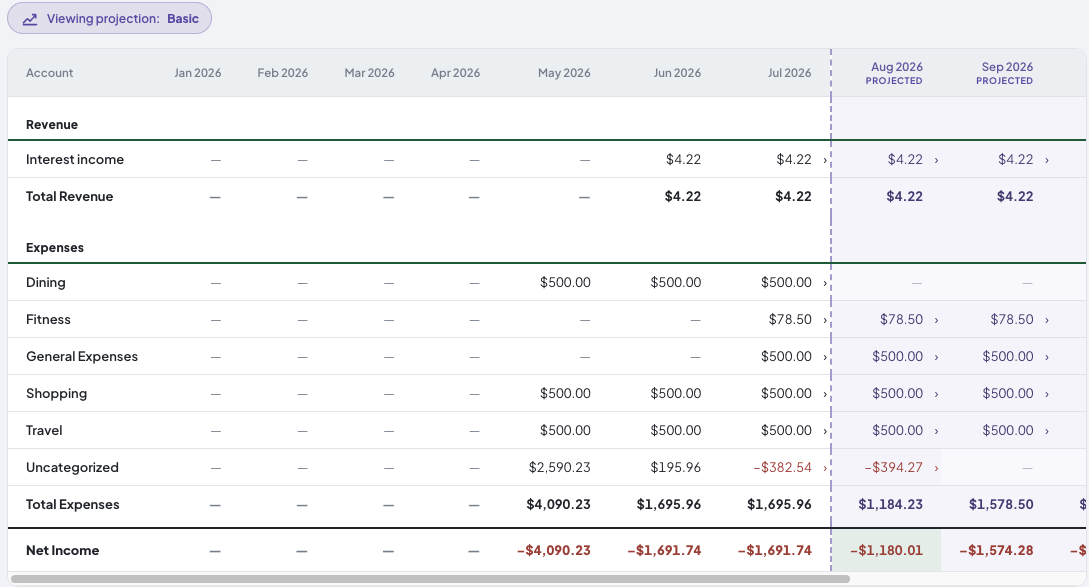
An income statement in mini-me: revenue and expense accounts by month, with the next two months projected from the books.

Plainly, before you connect a single account.

It’s your database, not a row in mine

One instance per person, open formats, full export, open-source core. If this went away, your books would still open.

Read-only, and no money moves

Bank links see transactions and nothing else. mini‑me never touches a payment.

If an account can’t be linked, upload it

Drop in the statement and mini‑me works out which account it belongs to, then books it like any other. Nothing gets left out because Plaid doesn’t cover it.

Claude reads only when asked

The app is fully usable without it, and the numbers always come from the ledger rather than the model.

Keep the spreadsheet running

Everything exports. Run both for a quarter and keep whichever one you actually open. Start with two accounts, not eleven.

Questions people actually ask.

What if Plaid doesn’t support one of my accounts?

Upload the statement instead. mini‑me reads it, works out which of your accounts it belongs to, and books the transactions exactly as it would for a linked one. Some accounts here work that way permanently.

Do I have to categorise everything myself?

No. Transactions categorise themselves, and correcting one is a button rather than a form. The correction sticks.

How far back can it go?

As far back as you have statements. Linked accounts bring their available history, and anything older you can upload, so you can close out a year that’s already finished.

Do I need to know accounting?

Not at all. The statements are already built and everything is labelled in plain words. The accounting is why the answers are right, not something you have to operate.

How long does setup take?

An hour or so with me, mostly logins. Start with the two or three accounts most of your money runs through; the picture is useful well before everything is in.

Start with the question that’s been bothering you.

Instances go out gradually, because each one is a real database I stand up and support with you. What early users keep asking is what gets built into the app next.